
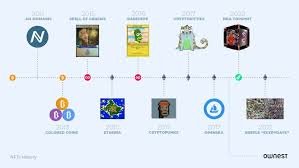
The first NFT was created on May 3, 2014. It sold for $4. Seven years later, a single NFT would sell for $91.8 million.
The story of when NFTs started isn’t a single moment – it’s a decade-long evolution from obscure blockchain experiments to mainstream cultural phenomenon to market collapse to quiet infrastructure rebuild.
2012-2013: Before NFTs Existed
The concept of unique digital tokens predates the term “NFT” by several years. Colored Coins on Bitcoin (2012) were an early attempt to represent real-world assets on a blockchain. They were limited by Bitcoin’s scripting language but planted the seed for unique digital tokens.
Dogecoin launched in December 2013 as a joke about Bitcoin. It wasn’t an NFT, but it demonstrated something important: crypto assets could carry cultural meaning beyond financial utility. That insight would eventually fuel the entire NFT market.
2014: The First NFT
On May 3, 2014, artist Kevin McCoy and technologist Anil Dash created “Quantum” – widely recognized as the first known NFT. It was minted on the Namecoin blockchain and sold for $4 at a live presentation at the New Museum in New York.
Quantum was a simple animated octagon. But the underlying concept was revolutionary: a digital artwork with provably unique, blockchain-verified ownership that could be transferred between individuals without an intermediary.
McCoy and Dash called their system “monetized graphics.” The term “NFT” wouldn’t catch on for several more years.
2015-2016: Early Experiments
2015: Etheria launched at DEVCON 1, Ethereum’s first developer conference. It allowed users to buy and sell hexagonal tiles on a virtual map – essentially the first NFT-based virtual land project. All 457 tiles were claimed, though most sat untouched until the 2021 boom when they suddenly became valuable.
2016: Rare Pepes emerged on the Bitcoin blockchain through the Counterparty protocol. Digital trading cards featuring variations of Pepe the Frog could be created, bought, and sold with verifiable scarcity. Rare Pepes built the first true NFT collector community and directly influenced later projects.
2017: The Breakout Year
Three projects launched in 2017 that defined the NFT space for years to come:
Curio Cards (May 2017) became Ethereum’s first art NFT project – a collection of 30 unique digital artworks by seven artists. They predate CryptoPunks by a month and are now considered historically significant early NFTs.
CryptoPunks (June 2017) launched 10,000 algorithmically generated pixel characters – each unique, each free to claim for anyone with an Ethereum wallet. Created by Larva Labs (Matt Hall and John Watkinson), CryptoPunks established the generative PFP collection model that would define the entire 2021 boom.
CryptoKitties (November 2017) became the first mainstream NFT application. Players bred and traded virtual cats with unique genetic traits. The game went so viral it congested the entire Ethereum network, proving both the demand for blockchain-based digital collectibles and the scaling limitations of Ethereum at the time.
CryptoKitties also pioneered the ERC-721 token standard – the technical foundation that would underpin virtually every NFT created on Ethereum afterward.
2018: The Standard
The ERC-721 Non-Fungible Token Standard was formally published in 2018, led by William Entriken. This standardized how unique tokens are created, transferred, and managed on Ethereum – giving developers a reliable framework for building NFT applications.
Six months later, ERC-1155 was approved, allowing multiple NFTs to share a single smart contract and reducing gas costs for large collections.
The market itself remained quiet. NFTs were a niche interest within the Ethereum developer community. The broader public had no idea they existed.
2019-2020: Building Momentum
2019: The NFT market slowly grew. NBA Top Shot launched through a partnership between the NBA and Dapper Labs, letting fans buy NFT “moments” – short video highlights of iconic basketball plays. SuperRare and Rarible established themselves as art-focused marketplaces.
2020: The market tripled to $250 million in total volume. DeFi summer brought a wave of new users into the Ethereum ecosystem. Artists began recognizing NFTs as a new distribution channel. The foundation for the 2021 explosion was set.
2021: The Boom
Everything detonated at once. NFT trading volume hit $17 billion – up from $82 million the year before.
The defining moments:
- March: Beeple’s Everydays: The First 5000 Days sold at Christie’s for $69.3 million
- December: Pak’s The Merge sold for $91.8 million across 28,893 buyers
- OpenSea reached a $1.4 billion market cap
- CryptoPunks and Bored Apes became cultural symbols
- Celebrities, brands, and sports leagues flooded in
- ArtReview ranked ERC-721 as the “#1 most powerful entity in art”
2022-2023: The Crash
By May 2022, daily NFT sales dropped 92% from peak. The crypto winter, Terra/Luna collapse, and FTX implosion devastated the broader market. By September 2023, 95% of NFTs had zero monetary value.
The one significant technical development: Bitcoin Ordinals launched in December 2022, introducing NFTs to the Bitcoin blockchain for the first time.
2024-2026: The Rebuild
CryptoPunks proved resilient with multi-million dollar resales in 2024. Enterprise adoption accelerated. Utility NFTs – ticketing, identity, loyalty – grew steadily. The NFT market stabilized around $2.6 billion in cap with 80% year-over-year growth in active participation.
NFTs in 2026 look nothing like 2021. The speculation died. The infrastructure persisted. And the technology that started with a $4 octagon in 2014 now powers event tickets, digital identities, creator royalties, and enterprise operations across dozens of blockchains.
Full NFT Timeline at a Glance
- 2014: Quantum – first NFT, sold for $4
- 2015: Etheria – first virtual land NFT
- 2016: Rare Pepes – first NFT trading cards on Bitcoin
- 2017: CryptoPunks, CryptoKitties, Curio Cards
- 2018: ERC-721 standard published
- 2019: NBA Top Shot launched
- 2020: Market triples to $250M
- 2021: $17B volume, Beeple $69.3M, Merge $91.8M
- 2022: Market crashes 92%, Bitcoin Ordinals launched
- 2023: 95% of NFTs worthless
- 2024: CryptoPunk resales above $16M
- 2025-2026: Utility-driven rebuild, enterprise adoption at 40%+ Fortune 500
FAQ
What was the first NFT ever made?
Quantum by Kevin McCoy and Anil Dash, created on May 3, 2014, on the Namecoin blockchain. It sold for $4 at a New Museum presentation in New York.
When did NFTs become popular?
NFTs entered mainstream awareness in early 2021 when Beeple’s Everydays sold for $69.3 million at Christie’s. Trading volume surged from $82 million in 2020 to $17 billion in 2021.
How old are NFTs?
The first NFT was created in 2014, making the technology approximately 12 years old as of 2026. The ERC-721 standard that formalized NFTs on Ethereum was published in 2018. Mainstream adoption began in 2021.