
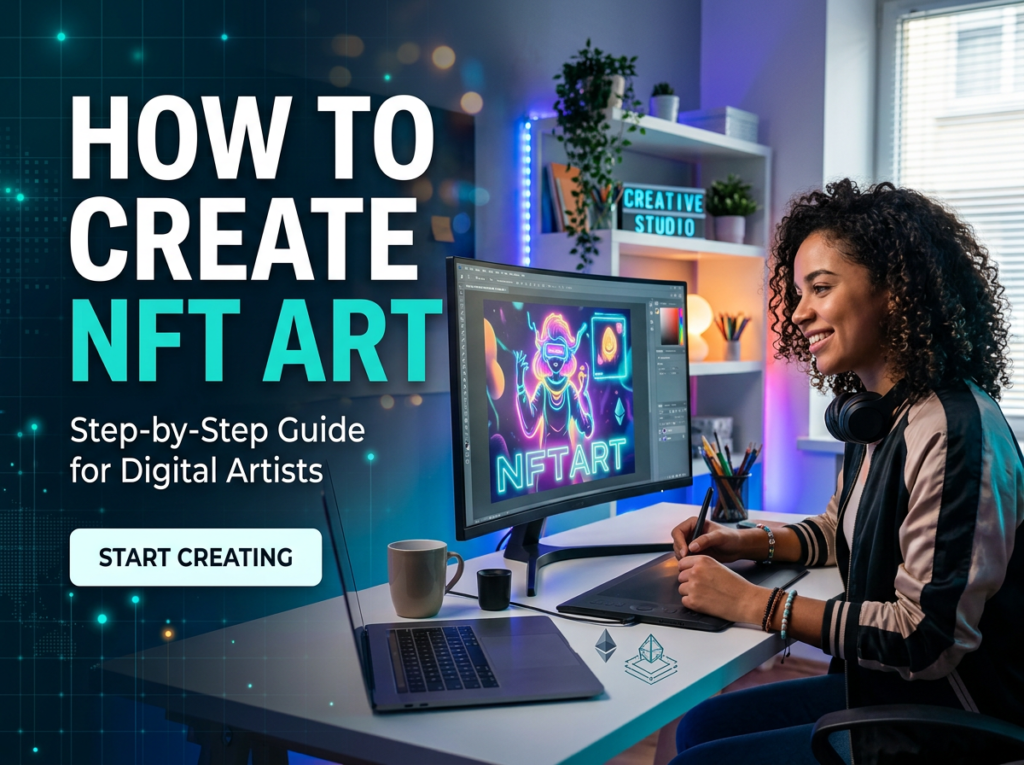
Creating NFT art isn’t about chasing the next $69 million headline – those days are behind us. In 2026, NFT art is a practical tool for artists who want verifiable ownership, built-in royalties, and direct access to collectors without galleries or middlemen.
The good news: you don’t need to be a developer. You don’t even need to be a digital artist. If you can create something visual – whether that’s a Procreate illustration, an oil painting, or a set of AI-generated images – you can turn it into an NFT.
This guide walks you through the entire process, from your first sketch to your first sale.
What Is NFT Art?
NFT art is any artwork – digital or digitized – that has been minted as a non-fungible token on a blockchain. The NFT itself isn’t the artwork. It’s a unique digital certificate that proves who created it, who owns it, and the full history of every transaction since it was minted.
The artwork can be an image, a video, a GIF, a music file, a 3D model, or even an animation. Traditional painters, photographers, and illustrators can also participate by scanning or photographing their physical work and minting the digital version.
What makes NFT art different from a regular JPEG? Anyone can right-click and save the image. But only one person holds the token that proves ownership on the blockchain – and that ownership is public, permanent, and verifiable by anyone.
What You Need Before You Start
Before diving into the steps, make sure you have these ready:
Your artwork. Either a finished digital piece or a physical artwork you can scan at 300dpi or higher. Accepted formats vary by marketplace, but PNG, JPEG, GIF, SVG, MP4, and MP3 are standard.
A crypto wallet. This is where you’ll store cryptocurrency, pay gas fees, and receive payments from sales. MetaMask is the most common for Ethereum-based NFTs; Phantom works for Solana.
A small amount of cryptocurrency. You’ll need ETH, SOL, or MATIC (depending on your chosen blockchain) to cover minting fees. On some chains, this can be less than a dollar.
A marketplace account. OpenSea, Rarible, Magic Eden, or SuperRare – each has its own strengths, and your choice depends on your blockchain and art style.
Basic blockchain knowledge. You don’t need to understand smart contract code, but knowing which chain you’re on and why matters for costs, speed, and audience reach.
How to Create NFT Art: Step by Step
Step 1: Create or Digitize Your Artwork
You have two paths here.
Digital-native art. Create directly on screen using tools like Adobe Photoshop, Illustrator, Procreate (iPad), Blender (for 3D), or AI image generators like Midjourney, DALL-E, or Stable Diffusion. Any digital format works – static images, animated GIFs, looping videos, or audio-visual pieces.
Physical art gone digital. If you’re a painter, illustrator, or photographer, scan your work at a minimum of 300dpi. You can use a home scanner or visit a professional print shop for larger pieces. The goal is a high-resolution digital file that faithfully represents your original.
Before creating, spend time researching what’s currently selling. Browse top collections on OpenSea and Magic Eden. Notice patterns – themed series outperform random one-offs. Aim for a cohesive collection of at least 5–10 pieces that share a visual style, subject, or narrative.
For generative collections (thousands of unique variations), you create individual trait layers – backgrounds, bodies, eyes, accessories, clothing – that a tool combines randomly into unique pieces. No-code platforms like OneMint, BuenoArt, and Bueno handle this automatically. OneMint alone has generated over 3 million images across 250,000+ collections. You upload your layers, set rarity for each trait, and the tool generates every combination with matching metadata.
Step 2: Choose Your Blockchain
Your blockchain choice determines your costs, speed, audience, and which marketplaces you can use. Here’s how the main options compare for NFT minting in 2026:
Ethereum – the original and most established NFT blockchain, powering roughly 62% of all NFT contracts. It has the largest collector base and widest marketplace support. The downside is cost: minting fees typically range from $15–$50 during normal traffic and can spike to $100+ during congestion. Ethereum uses the ERC-721 token standard, which is the foundation of the NFT ecosystem. Since the September 2022 Merge to proof-of-stake, its energy consumption dropped by approximately 99.95%.
Solana – fast, cheap, and growing. Minting costs are typically under $0.01–$0.10 per transaction. Solana handles roughly 18% of NFT transactions and is favored by creators who want to experiment without high upfront costs. Magic Eden is the leading Solana marketplace.
Polygon – an Ethereum Layer 2 solution with extremely low fees (under $0.01 per mint). It’s compatible with Ethereum wallets and tools, which means you get Ethereum ecosystem access at a fraction of the cost. Brands like Starbucks and Nike have used Polygon for their NFT projects. OpenSea supports lazy minting on Polygon with zero upfront gas fees.
The bottom line: if you’re minting your first collection and want minimal financial risk, start with Polygon or Solana. If you’re targeting high-end collectors and can afford the fees, Ethereum offers the deepest market.
Step 3: Set Up a Crypto Wallet
Your wallet is your identity in the NFT world. It holds your crypto, stores your NFTs, and connects to marketplaces.
MetaMask is the most widely used wallet for Ethereum and Polygon. It’s available as a browser extension (Chrome, Firefox, Brave) and a mobile app. Setup takes minutes: install the extension, create a password, and you’ll receive a 12-word recovery phrase.
Phantom is the go-to wallet for Solana. Clean interface, fast, and built specifically for the Solana ecosystem.
Coinbase Wallet supports multiple chains and is beginner-friendly – a solid option if you’re already using Coinbase as an exchange.
Ledger Nano X is a hardware wallet for maximum security. Your private keys never touch the internet, which protects you from phishing attacks. Recommended if you plan to hold valuable NFTs long-term.
One critical rule: write down your recovery phrase on paper and store it somewhere safe. If you lose it, you lose access to your wallet permanently. No one can recover it for you – not the wallet company, not the marketplace, not the blockchain.
Step 4: Buy Cryptocurrency for Gas Fees
Gas fees are the cost of processing your transaction on the blockchain. They’re not a payment for the NFT itself – they’re the fee you pay to validators who confirm and record your mint.
Here’s what you’ll need:
- Ethereum minting: Buy ETH. Budget $20–$100 to be safe, depending on network congestion.
- Solana minting: Buy SOL. A few dollars is more than enough.
- Polygon minting: Buy MATIC (or use lazy minting on OpenSea for zero upfront cost).
Purchase crypto on an exchange like Coinbase, Kraken, or Binance, then transfer it to your wallet address.
Pro tip: on Ethereum, gas fees fluctuate by the hour. Minting on weekends or during off-peak hours (2–6 AM UTC) can save you 40–60% compared to weekday peaks. Tools like Etherscan’s Gas Tracker show real-time prices.
Lazy minting is available on platforms like OpenSea and Rarible for Ethereum and Polygon. With lazy minting, you pay zero gas upfront – the buyer pays the minting fee when they purchase. This is the best option for new artists testing the market without financial risk.
Step 5: Choose a Marketplace and Connect Your Wallet
Each marketplace has a different vibe, audience, and fee structure.
OpenSea is the largest general-purpose NFT marketplace. It supports 9 blockchains (including Ethereum, Polygon, Solana, Arbitrum, Base, and more), accepts multiple wallet types, and charges a 2.5% fee on sales. It lists everything: art, photography, music, gaming items, domain names, and virtual worlds. Best for beginners and broad reach.
Rarible supports 8+ blockchains and offers flexible selling options – fixed price, timed auction, or open-bid auction with no time limit. It has a clean creator interface and its own RARI governance token.
SuperRare is a curated, invitation-based platform focused on high-end digital art. Ethereum only. If you want prestige and are willing to apply for approval, SuperRare connects you with serious collectors. The community of RARE token holders votes on which new artists to feature.
Magic Eden leads the Solana and Bitcoin Ordinals market. If you’re minting on Solana, this is your primary destination.
To connect: visit your chosen marketplace, click “Connect Wallet,” select your wallet provider (MetaMask, Phantom, etc.), and approve the connection in your wallet app. That’s it – you’re linked.
Step 6: Upload and Mint Your NFT
This is where your art becomes a token on the blockchain.
Click “Create” on your marketplace, then upload your file. You’ll be prompted to fill in:
- Name – make it distinctive and searchable.
- Description – tell the story behind the piece. What inspired it? What does it represent? Collectors value narrative.
- Properties/Traits – for collections, add attributes like “Background: Blue,” “Eyes: Laser,” “Rarity: Legendary.” These are crucial for generative collections and help buyers filter and discover your work.
- Unlockable content (optional) – bonus materials that only the buyer can access after purchase. This could be a high-resolution file, a behind-the-scenes video, a discount code, or an invitation to a private community.
You can mint a single piece (a 1/1, highly valued by collectors) or create an entire collection.
When you confirm, the marketplace will prompt you to approve the transaction in your wallet and pay the gas fee (unless you’re using lazy minting). Once confirmed, your NFT is live on the blockchain with a unique identifier, your wallet address as creator, and the metadata you entered.
Step 7: Set Your Price and List for Sale
You have several pricing strategies:
Fixed price – simplest option. You set the amount, and the first buyer who meets it gets the NFT. Best for new artists who want predictable outcomes.
English auction (timed) – you set a starting price and a deadline. Buyers bid against each other, and the highest bid wins when time runs out. Creates excitement and can drive the price above expectations.
Dutch auction (descending) – you set a high starting price that drops at regular intervals until someone buys. Useful for testing what the market will pay.
Open bid (no reserve) – no minimum price, no deadline. Buyers submit offers and you accept when you’re satisfied. Highest risk, but reveals your art’s true market value.
Don’t forget royalties. Most platforms let you set a royalty percentage – typically 5–10% – that you earn automatically every time your NFT is resold on the secondary market. This is one of the most powerful features for artists: you continue earning from your work indefinitely. Smart contracts handle this automatically with no intermediary.
How to Promote Your NFT Art
Minting your NFT is only half the job. Without promotion, even great art sits unsold. This is the step most guides skip – and it’s the one that matters most.
Build your audience before you mint. The artists who succeed in NFTs almost always had a following before they entered the space. A mailing list, an Instagram account, a Twitter/X presence – any existing audience gives you a head start.
Twitter/X is the hub. The NFT community lives on Twitter/X. Share your work-in-progress, your creative process, and engage with other artists and collectors. Use relevant hashtags, join Spaces conversations, and be genuinely present – not just promotional.
Discord is for community. Many successful NFT projects run Discord servers where collectors gather. Join existing communities, contribute meaningfully, and eventually build your own. A Discord server turns one-time buyers into long-term supporters.
Tell the story. Collectors don’t just buy images – they buy into narratives. Why did you create this collection? What does it mean to you? What world does it live in? Digital storytelling turns anonymous art into something people want to own.
Collaborate. Partner with other NFT artists for cross-promotion. Feature each other’s work, create joint collections, or host joint Twitter Spaces. The NFT art community rewards generosity and collaboration over self-promotion.
Be consistent. One drop and silence doesn’t build a collector base. Regular releases, updates, and engagement build trust. Treat your NFT art like a brand, not a lottery ticket.
Best Tools for Creating NFT Art
Art Creation Tools
For digital painting and illustration: Adobe Photoshop, Adobe Illustrator, Procreate (iPad), Clip Studio Paint, Krita (free).
For 3D art: Blender (free, open-source), Cinema 4D, ZBrush.
For AI-assisted art: Midjourney, DALL-E, Stable Diffusion, Adobe Firefly. These can generate base images that you then refine, or serve as creative starting points.
For traditional art: a scanner at 300dpi minimum (home scanner or professional service like FedEx/Kinkos). For large canvases, a high-resolution camera with consistent lighting works too.
Generative Collection Tools
If you want to create thousands of unique variations from trait layers (the way Bored Apes and CryptoPunks were made), these no-code tools handle the entire process:
OneMint (nft-generator.art) – $100 flat fee. Supports Ethereum, Solana, Polygon, Binance, MultiversX. Includes smart contract deployment, rarity settings, metadata generation, GIF/video export, and dynamic NFTs. Over 3 million images generated to date.
BuenoArt – 1 ETH + 5% of sales. Includes art generation, smart contracts, and access list management.
NFTInator– $149.99 + 2% + $99. Includes art generation, smart contracts, and basic rules.
All three let you upload trait layers, configure rarity, preview combinations, and export ready-to-mint collections with compliant metadata – zero coding required.
Wallets and Marketplaces at a Glance
Wallets: MetaMask (Ethereum/Polygon), Phantom (Solana), Coinbase Wallet (multi-chain), Ledger Nano X (hardware security).
Marketplaces: OpenSea (largest, multi-chain), Rarible (flexible auctions), SuperRare (curated high-end), Magic Eden (Solana/Ordinals), Foundation (curated, Ethereum).
NFT Collections That Inspire
Looking at successful projects can sharpen your creative direction. Here are four that defined different approaches:
Bored Ape Yacht Club – 10,000 unique generative apes, each assembled from randomized trait layers. Ownership grants IP rights to holders, access to private online groups, exclusive merch, and real-world events. BAYC proved that collections thrive when they offer community and utility beyond the image itself.
CryptoPunks – 10,000 algorithmically generated 24×24 pixel characters, launched in 2017. Widely considered the first NFT collection on the blockchain. Countless varieties of hats, glasses, hairstyles, and accessories. The project showed that simplicity and scarcity create collector obsession.
Cool Cats – 9,999 randomly generated cartoon cats. Holders receive raffles, giveaways, and community benefits. A more accessible, lighthearted entry point to the generative collection space.
World of Women – 10,000 digital portraits celebrating women from diverse backgrounds. Inspired by Frida Kahlo and other iconic female artists. The project actively supports women’s rights movements and demonstrated that NFTs can carry real social purpose.
Each of these collections succeeds because it combines strong art with a clear narrative, community, and something beyond the image.
Common Mistakes to Avoid
Minting without an audience. The biggest mistake new NFT artists make is listing art and expecting buyers to find it. No audience means no sales. Build your presence first, even if it takes months.
Ignoring gas fee timing. On Ethereum, minting during peak hours can cost 5–10x more than off-peak. Check Etherscan Gas Tracker before you confirm any transaction. Or use Polygon/Solana to avoid this problem entirely.
Skipping royalties. If you don’t set royalty percentages during minting, you miss out on passive income from every future resale. Always configure this – 5–10% is standard.
Choosing the wrong blockchain for your audience. Ethereum has the most collectors but the highest fees. If your art is priced under $50, Ethereum gas fees could exceed the sale price. Match your chain to your price point and target market.
No collection theme or narrative. Random, unrelated pieces don’t build collector interest. A cohesive theme – visual style, subject matter, lore – gives buyers a reason to collect multiple pieces and follow your future work.
Neglecting metadata. Vague titles like “Untitled #47” and empty descriptions kill discoverability. Write compelling titles, detailed descriptions, and accurate trait properties. This is how buyers find and filter your work.
Not understanding copyright. When you sell an NFT, you sell the token – not necessarily the copyright. Unless you explicitly transfer intellectual property rights in your terms, you retain the copyright to the artwork. Make this clear to avoid disputes.
Storing art on centralized servers. If your NFT’s image is hosted on a regular web server and that server goes down, your NFT points to nothing. Use decentralized storage like IPFS (InterPlanetary File System) or Arweave for permanent, censorship-resistant file hosting. Most reputable marketplaces handle this automatically, but verify.
Is It Still Worth Creating NFT Art in 2026?
Let’s be honest: the speculative frenzy is over. The cumulative NFT market cap has dropped roughly 99% from its 2023 peak. Most art-focused NFTs from the 2021 boom are worthless. If you’re entering this space hoping to flip a JPEG for a quick fortune, the window for that closed years ago.
But here’s what’s still alive – and growing:
Artist royalties work. The ability to earn 5–10% on every resale, automatically, forever, is something traditional art markets have never offered. For working artists, this is genuinely revolutionary infrastructure.
Utility-based NFTs are expanding. Event tickets, loyalty programs, membership passes, identity verification – these are growing use cases where the token’s value comes from what it does, not speculation.
Enterprise adoption is real. Over 40% of Fortune 500 companies now use NFTs in some operational capacity. The technology matured even as the speculative market crashed.
Direct-to-collector relationships persist. Artists who built genuine communities around their work – not hype – still sell consistently. The market rewards authenticity and consistency over virality.
The honest advice: create NFT art because you believe in the work and want to explore a new distribution model. Treat royalties as a long-term play. Build community. And never invest more than you can afford to lose.
Frequently Asked Questions
How much does it cost to create an NFT?
It depends entirely on the blockchain. On Ethereum, minting costs typically range from $15–$50 during normal traffic but can spike much higher. On Solana, it’s usually under $0.10. On Polygon, minting can be essentially free using lazy minting (the buyer pays the gas fee upon purchase). Marketplace service fees (typically 2.5% on OpenSea) are additional and come out of the sale price.
Can I create an NFT for free?
Yes. OpenSea and Rarible support lazy minting on Ethereum and Polygon, which means you pay zero gas upfront. The NFT is minted on-chain only when a buyer purchases it, and the gas fee is covered by the buyer. Your only cost is the time spent creating the art and setting up the listing.
What file formats can be used for NFT art?
Most marketplaces accept PNG, JPEG, GIF, SVG, MP4, WEBM, MP3, WAV, GLB, and GLTF (for 3D). File size limits vary – OpenSea currently allows up to 50MB per file. For best results, use high-resolution PNG or JPEG for static images, MP4 for video, and GIF for animated loops.
Do I need to know coding to create an NFT?
No. Platforms like OpenSea, Rarible, and Magic Eden handle the entire minting process through a visual interface – upload, fill in details, confirm, done. For generative collections (thousands of unique pieces from trait layers), no-code tools like OneMint and BuenoArt eliminate the need for programming entirely.
Can I sell physical art as an NFT?
Yes. Scan or photograph your physical artwork at 300dpi or higher to create a high-quality digital file, then mint that file as an NFT. Some artists sell the NFT as a standalone digital collectible; others bundle it with the physical piece, using the NFT as a certificate of authenticity and provenance. The token proves the artwork’s origin and ownership history on the blockchain regardless of what happens to the physical piece.